


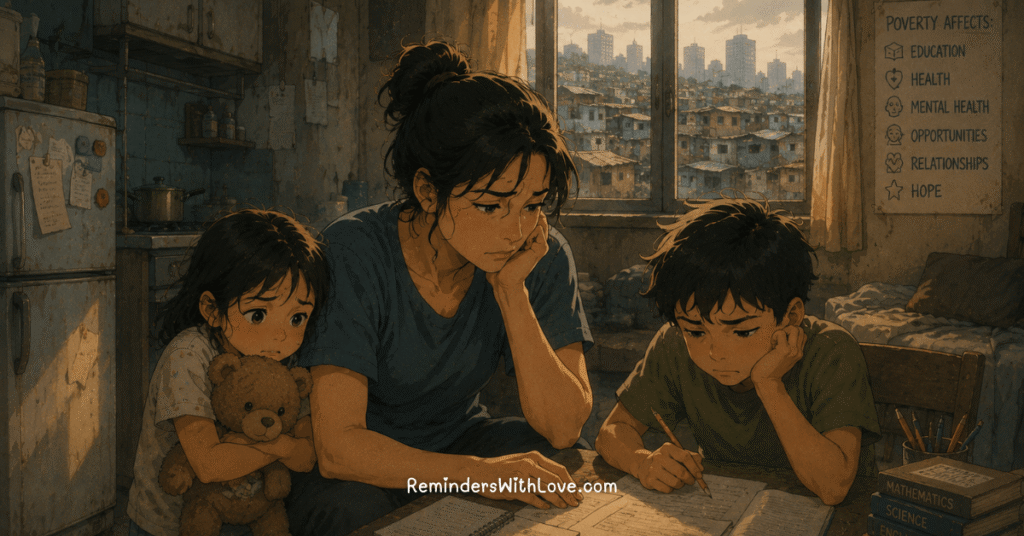
Discover how poverty influences wellbeing, relationships, education, health, opportunity, and community life far beyond financial hardship alone.
Have you ever heard someone say, “Poverty is just about not having enough money”?
At first glance, that statement may seem true. After all, poverty is often measured through income, employment, and financial resources.
But what if poverty affects far more than a person’s bank account?
What if it influences health, education, relationships, opportunities, confidence, community participation, and even the way people experience daily life?
For decades, researchers, social workers, public health professionals, and community organizations have studied poverty and its impact on individuals and families. Their findings consistently reveal that poverty is not simply a financial issue.
It is also a social issue, a community issue, and a human wellbeing issue.
Understanding poverty requires looking beyond income and examining the wider challenges that often accompany financial hardship.
Doing so helps us better understand the experiences of millions of people around the world and the importance of creating communities where everyone has opportunities to thrive.
What Is Poverty?
Poverty is commonly defined as a lack of sufficient resources to meet basic needs.
These needs may include:
- Food
- Housing
- Healthcare
- Education
- Transportation
- Clothing
- Utilities
However, many researchers argue that poverty should not be understood solely in terms of money.
Poverty can also affect access to opportunities, social participation, and quality of life.
For example, two families may have similar incomes but very different access to:
- Safe neighborhoods
- Quality education
- Healthcare services
- Community support
- Employment opportunities
This broader perspective helps explain why poverty influences so many areas of life.
Why Is Poverty More Than a Financial Problem?
Financial hardship rarely exists in isolation.
When resources are limited, people often face multiple interconnected challenges.
For example, insufficient income may affect:
- Housing stability
- Access to nutritious food
- Educational opportunities
- Transportation options
- Healthcare access
Each of these factors can influence overall wellbeing.
As a result, poverty often creates a chain of difficulties that extend beyond finances alone.
This is why social workers frequently describe poverty as a complex social issue rather than simply a lack of income.
How Does Poverty Affect Daily Life?
One of the most overlooked aspects of poverty is the constant pressure it can create.
Many individuals experiencing financial insecurity must regularly make difficult decisions about limited resources.
Questions may include:
- Which bill should be paid first?
- Can food expenses be stretched until next week?
- Is transportation affordable?
- Can medical appointments be attended?
- Is childcare available?
These concerns can become part of everyday life.
When people spend significant time managing financial uncertainty, it can affect how they plan, prioritize, and navigate daily responsibilities.
This does not mean poverty defines people’s abilities or character.
Rather, it highlights how financial insecurity can shape daily experiences.
How Does Poverty Affect Family Wellbeing?
Families often experience poverty collectively rather than individually.
Financial hardship can influence family life in several ways.
For example, families may face:
- Housing instability
- Limited educational resources
- Reduced access to recreational opportunities
- Transportation challenges
- Increased caregiving pressures
Parents frequently work hard to protect children from financial stress.
However, economic challenges can still affect family routines and opportunities.
Importantly, poverty does not determine the quality of parenting or family relationships.
Many families demonstrate remarkable resilience, love, and support despite financial hardship.
Nevertheless, limited resources can create additional pressures that families must navigate.
Why Does Poverty Affect Educational Opportunities?
Education is often viewed as a pathway to opportunity.
However, poverty can influence educational experiences in various ways.
Challenges may include:
- Limited access to learning materials
- Technology gaps
- Transportation barriers
- Housing instability
- Fewer extracurricular opportunities
These barriers do not reflect a lack of intelligence, motivation, or potential.
Rather, they illustrate how economic circumstances can affect access to resources that support learning.
Researchers often emphasize that educational outcomes are influenced not only by individual effort but also by social and economic conditions.
How Does Poverty Affect Health and Wellbeing?
Health and poverty are closely connected.
People experiencing financial hardship may encounter barriers to:
- Healthcare services
- Preventive care
- Nutritious food
- Safe housing
- Physical activity opportunities
These factors can influence overall health outcomes.
Public health researchers frequently describe health as being shaped by social determinants—conditions within the environments where people live, work, and learn.
Income is one of those factors.
However, it interacts with many others, including housing, education, employment, and community resources.
Understanding these connections helps explain why poverty is often viewed as both a social and health issue.
How Does Poverty Influence Opportunity?
Opportunity is not distributed equally across all communities.
Economic hardship can affect access to:
- Education
- Employment networks
- Professional development
- Transportation
- Community resources
These factors may influence future opportunities and life trajectories.
Importantly, poverty does not eliminate talent, ambition, creativity, or potential.
Many successful individuals have overcome significant economic challenges.
However, social workers and researchers recognize that opportunities are often shaped by broader social and economic conditions.
Addressing poverty therefore involves considering both individual effort and structural barriers.
Why Can Poverty Lead to Social Exclusion?
Poverty may also affect participation in community life.
Limited financial resources can create barriers to:
- Social activities
- Community events
- Recreational opportunities
- Memberships and programs
- Transportation to community spaces
As a result, some individuals may feel isolated or excluded.
Social exclusion can affect a person’s sense of belonging and connection.
This is one reason social workers often focus on both financial support and social inclusion.
Communities thrive when people have opportunities to participate and feel connected.
Why Is Poverty a Community Issue?
Poverty affects entire communities, not just individuals.
Communities experiencing higher levels of economic hardship may face challenges related to:
- Housing
- Education
- Public health
- Employment
- Infrastructure
However, communities also possess strengths.
Strong social networks, local organizations, volunteers, and community initiatives often help support individuals facing hardship.
This highlights an important principle within social work:
People do not exist separately from their environments.
Individual wellbeing and community wellbeing are closely connected.
What Role Does Social Work Play in Addressing Poverty?
Social work approaches poverty from a broad perspective.
Rather than focusing solely on income, social workers examine how economic hardship affects people’s lives, opportunities, and participation in society.
Questions may include:
- What barriers exist?
- What resources are available?
- How can support systems be strengthened?
- How can opportunities be improved?
Social workers often advocate for:
- Access to resources
- Community support
- Educational opportunities
- Social inclusion
- Fair access to services
The goal is not only to address immediate needs but also to strengthen conditions that support long-term wellbeing.
Why Is It Important to Challenge Stereotypes About Poverty?
One of the biggest misconceptions about poverty is that it reflects personal failure.
Research consistently shows that poverty is influenced by many factors, including:
- Economic conditions
- Employment opportunities
- Housing costs
- Education access
- Health challenges
- Community resources
Reducing poverty to individual choices overlooks these broader influences.
Understanding poverty requires empathy, awareness, and recognition of the complex circumstances people may face.
This perspective encourages more informed and compassionate conversations about economic hardship.
What Can Poverty Teach Us About Society?
Poverty reveals important truths about how societies function.
It highlights the connections between:
- Opportunity and access
- Resources and wellbeing
- Communities and individuals
It also reminds us that wellbeing is influenced by more than personal effort alone.
Social conditions matter.
Community resources matter.
Access matters.
Understanding these connections helps create more inclusive and supportive communities.
Final Thoughts
Poverty affects far more than income.
It influences health, education, family wellbeing, opportunity, social participation, and community life.
Understanding poverty as a complex social issue helps move the conversation beyond simple financial measures.
It encourages us to consider the broader conditions that shape people’s experiences and opportunities.
Most importantly, it reminds us that every person deserves the chance to participate fully in society and pursue a life of dignity, belonging, and opportunity.
Because poverty is not simply about having less money.
It is about how access, opportunity, and resources influence the quality of people’s lives.