


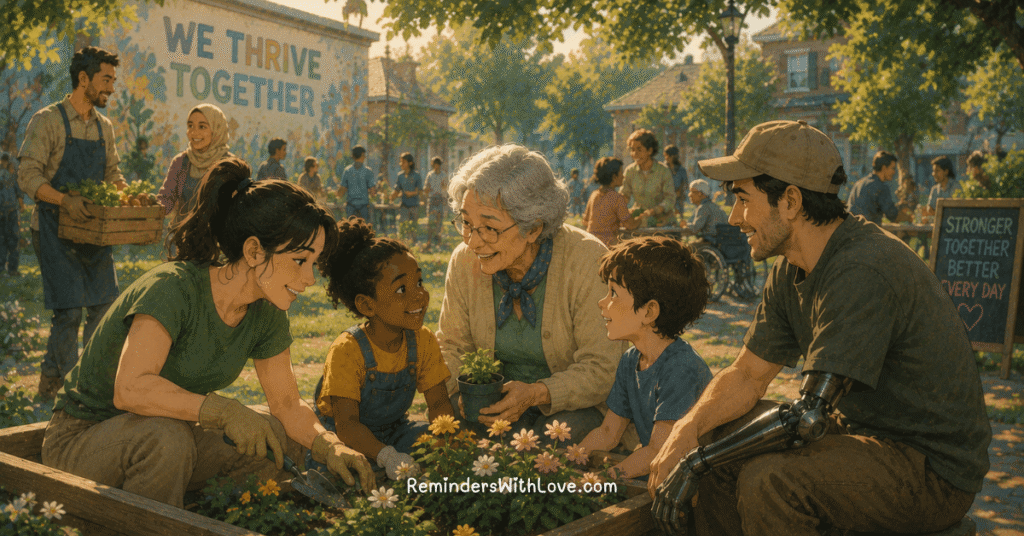
Discover why social inclusion is essential for community wellbeing, belonging, participation, and creating stronger, healthier, and more connected societies.
Have you ever lived, worked, or studied somewhere where people were physically present together but didn’t truly feel connected to one another?
Many communities today have schools, workplaces, parks, organizations, and public spaces filled with people. Yet despite being surrounded by others, many individuals still experience loneliness, exclusion, and a lack of belonging.
Why does this happen?
The answer often lies in the difference between simply having people present and genuinely including them.
This distinction is why social inclusion has become an increasingly important topic in social work, psychology, community development, public health, and social policy.
Communities thrive when people feel that they belong, that their voices matter, and that they have opportunities to participate fully in community life.
Without inclusion, even the most developed communities can struggle with division, isolation, and disconnection.
Understanding why inclusion matters helps us better understand what makes communities healthy, resilient, and supportive places to live.
What Is Social Inclusion?
Social inclusion refers to creating environments where people have meaningful opportunities to participate in social, economic, cultural, and community life.
Inclusion is about more than allowing people to be present.
It involves ensuring that individuals feel:
- Welcomed
- Respected
- Valued
- Heard
- Connected
- Able to participate
A truly inclusive community recognizes that every person has something valuable to contribute.
Inclusion focuses on removing barriers that prevent people from participating fully and ensuring that everyone has opportunities to belong.
Why Is Inclusion Different From Simply Being Present?
Many people assume that inclusion means inviting people into a space.
However, presence alone does not create belonging.
A person may attend meetings, classes, workplaces, or community events and still feel excluded.
For example:
- Their opinions may be ignored.
- Their needs may not be considered.
- They may feel different from others.
- They may struggle to participate fully.
Inclusion goes beyond physical access.
It involves creating conditions where people feel genuinely involved and respected.
This distinction is important because belonging often depends on the quality of participation rather than mere presence.
Why Do Humans Need Inclusion?
Human beings are social creatures.
For thousands of years, survival depended on belonging to groups and communities.
Being part of a group often provided:
- Protection
- Support
- Cooperation
- Shared resources
- Social learning
As a result, the need to belong became deeply embedded in human psychology.
Researchers consistently identify belonging as one of the most fundamental human needs.
People want to know:
- Do I matter here?
- Am I accepted?
- Am I valued?
- Do I belong?
Inclusion helps answer these questions positively.
When people feel included, they are more likely to engage, contribute, and connect with others.
How Does Inclusion Affect Individual Wellbeing?
The relationship between inclusion and wellbeing has been studied extensively.
People who feel included often experience:
- Greater life satisfaction
- Stronger social connections
- Increased confidence
- Higher levels of participation
- Greater sense of belonging
Feeling included reinforces the idea that individuals matter within their communities.
Conversely, persistent exclusion can contribute to:
- Loneliness
- Isolation
- Social withdrawal
- Reduced participation
This is why inclusion is increasingly recognized as an important factor influencing wellbeing.
People flourish when they feel connected to the communities around them.
Why Is Inclusion Important for Community Wellbeing?
Community wellbeing refers to the overall health, functioning, and quality of life within a community.
Strong communities are not built solely through infrastructure, services, or economic development.
They are built through relationships.
Inclusion strengthens these relationships by encouraging participation and connection.
Inclusive communities often demonstrate:
- Greater trust
- Stronger social networks
- Better cooperation
- Higher civic engagement
- Greater resilience
When people feel valued, they are more likely to contribute positively to community life.
This benefits both individuals and the community as a whole.
What Happens When Communities Lack Inclusion?
Exclusion affects more than the individuals who experience it.
It can influence entire communities.
When people feel disconnected or excluded, they may become less likely to:
- Participate in community activities
- Volunteer
- Share ideas
- Engage in local initiatives
- Build relationships with others
Over time, this can weaken community cohesion.
Communities may experience:
- Lower trust
- Reduced participation
- Greater division
- Increased social isolation
Inclusion helps prevent these outcomes by creating opportunities for people to feel connected and involved.
Why Does Inclusion Support Diversity?
Diversity and inclusion are closely connected.
Diversity refers to the presence of differences among people.
These differences may include:
- Age
- Culture
- Language
- Ability
- Background
- Experiences
- Perspectives
However, diversity alone does not guarantee positive outcomes.
A community can be highly diverse while still leaving certain groups feeling excluded.
Inclusion ensures that diversity becomes a strength rather than a source of division.
It creates opportunities for people from different backgrounds to participate meaningfully and contribute their perspectives.
Why Is Respecting Differences Important?
Communities consist of people with different experiences, identities, beliefs, and perspectives.
Respecting these differences helps create environments where people feel safe and valued.
Respect does not require agreement on every issue.
Instead, it involves recognizing the dignity and worth of every individual.
Respect can be demonstrated through:
- Listening
- Fair treatment
- Accessibility
- Inclusion in decision-making
- Recognition of different experiences
When people feel respected, they are more likely to engage positively with others and participate in community life.
Who Benefits Most From Inclusive Communities?
Everyone benefits from inclusion.
However, some groups may face greater barriers to participation than others.
These may include:
- Older adults
- Individuals with disabilities
- Refugees and newcomers
- People experiencing poverty
- Minority groups
- Socially isolated individuals
Inclusive communities work to reduce barriers and create opportunities for participation.
The goal is not special treatment.
The goal is ensuring that everyone has a fair opportunity to belong and contribute.
Why Is Inclusion a Core Social Work Value?
Social work has long emphasized the importance of participation, dignity, and social justice.
Social workers recognize that wellbeing is shaped not only by individual circumstances but also by social environments.
Questions commonly explored in social work include:
- Who is being left out?
- What barriers exist?
- How can participation be improved?
- How can communities become more welcoming?
This perspective reflects the belief that healthy communities should create opportunities for everyone to participate meaningfully.
Inclusion is therefore central to many social work approaches.
How Does Inclusion Strengthen Community Resilience?
Resilient communities are better able to respond to challenges such as:
- Economic difficulties
- Natural disasters
- Social change
- Public health concerns
Inclusion contributes to resilience because connected communities tend to cooperate more effectively.
When people feel that they belong, they are more likely to:
- Support one another
- Share resources
- Participate in problem-solving
- Engage in collective action
These qualities help communities adapt and recover during difficult times.
Inclusion strengthens the social bonds that resilience depends upon.
What Can Inclusion Teach Us About Human Nature?
Perhaps the most important lesson is that people want more than access.
They want belonging.
They want to feel seen.
They want to feel valued.
They want opportunities to contribute.
Inclusion reflects the understanding that every person matters and that communities function best when everyone has a chance to participate.
Human beings thrive when they feel connected to others.
Inclusion helps create those connections.
Final Thoughts
Social inclusion is not simply a social ideal.
It is a practical foundation for healthy communities.
When people feel welcomed, respected, and able to participate, communities become stronger, more connected, and more resilient.
Inclusion supports wellbeing by fostering belonging, encouraging participation, and strengthening relationships.
It helps transform groups of individuals into communities where people genuinely feel they matter.
Perhaps this is why inclusion matters so much.
Because communities thrive when people feel that they belong.
And when people belong, they are more likely to contribute, connect, and help create healthier communities for everyone.