
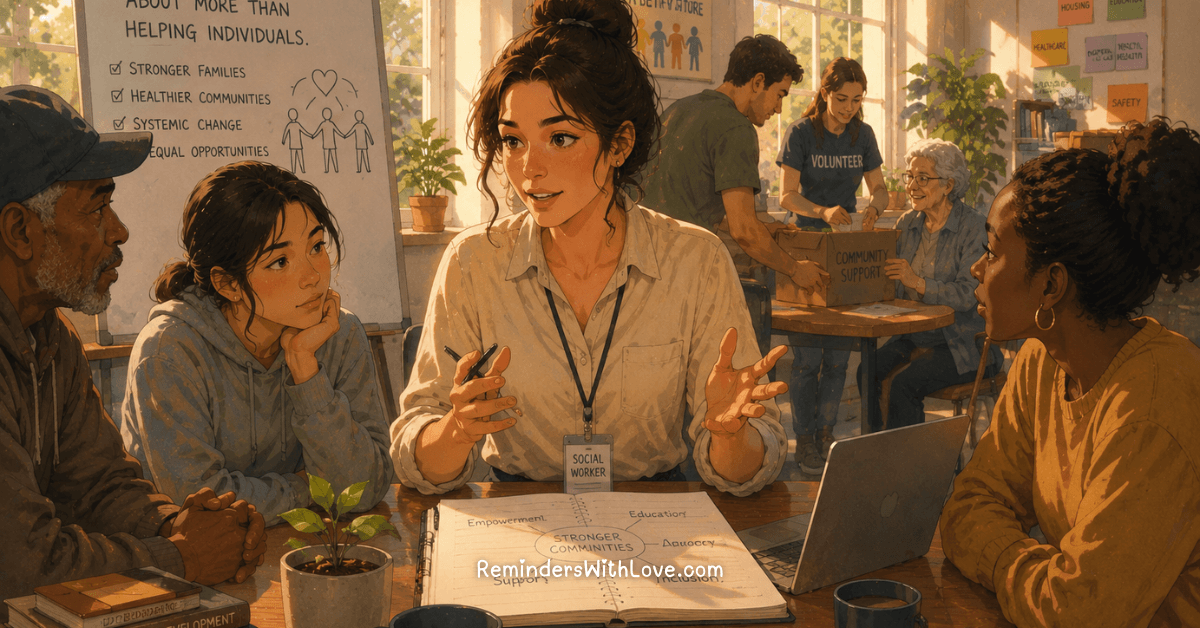
Discover why social work goes beyond helping individuals and focuses on families, communities, social systems, and the conditions that shape human wellbeing.
Have you ever wondered why two people facing the same challenge can have completely different outcomes in life?
Imagine two individuals who lose their jobs at the same time. One quickly finds support from family, accesses community resources, secures new opportunities, and recovers. The other struggles with financial stress, social isolation, housing concerns, and declining wellbeing.
The difference often goes far beyond personal choices or motivation.
Factors such as family support, community resources, social opportunities, economic conditions, education, and access to services all play a role.
This is one of the reasons social work exists.
Many people assume social work is simply about helping individuals solve personal problems. In reality, social work is much broader. It is a profession that seeks to understand how people are influenced by their families, communities, environments, and social systems.
To understand social work, we must move beyond the idea that people’s challenges exist in isolation.
Why Isn’t Social Work Just About Individuals?
Human beings do not live in isolation.
Every person exists within a network of relationships, communities, institutions, and social systems.
When someone experiences a challenge, that challenge is often connected to many other factors.
For example:
- A child’s school performance may be influenced by family stress.
- An older adult’s wellbeing may be affected by social isolation.
- Financial hardship may impact relationships and mental health.
- Housing instability may affect educational opportunities.
Social workers recognize that understanding the individual is important, but understanding the environment around the individual is equally important.
This broader perspective is one of the defining features of social work.
What Is the Person-in-Environment Perspective?
One of the most important concepts in social work is the person-in-environment perspective.
This approach recognizes that people’s lives are shaped by the interaction between personal experiences and social conditions.
Instead of asking only:
“What is wrong with this person?”
social workers often ask:
“What is happening in this person’s life, family, community, and environment?”
This shift in perspective changes how challenges are understood.
Rather than viewing difficulties solely as individual problems, social workers examine how broader circumstances may contribute to those experiences.
How Do Families Influence Wellbeing?
Families play a significant role in shaping human development and wellbeing.
Family relationships can provide:
- Emotional support
- Practical assistance
- Guidance
- Stability
- A sense of belonging
However, families can also experience challenges such as:
- Conflict
- Financial stress
- Caregiving pressures
- Loss
- Major life transitions
Because family relationships are so influential, social workers often work not only with individuals but also with family systems.
Helping one family member may sometimes require understanding the needs and experiences of the entire family.
Why Are Communities Important in Social Work?
Communities influence wellbeing in ways many people rarely consider.
A person’s quality of life may be affected by:
- Access to healthcare
- Education
- Transportation
- Employment opportunities
- Social support networks
- Recreational spaces
- Community programs
Strong communities often provide opportunities for connection, support, and growth.
Communities facing significant challenges may struggle to meet the needs of their residents.
This is why social workers frequently engage in community development and community wellbeing initiatives.
Their goal is not only to help individuals but also to strengthen the environments where people live.
How Does Social Work Address Social Problems?
Many challenges affecting individuals have broader social dimensions.
Examples include:
- Poverty
- Homelessness
- Domestic violence
- Disability-related barriers
- Social isolation
- Aging populations
- Educational inequalities
While these issues affect individuals directly, they also affect families, neighborhoods, and communities.
Social workers recognize that addressing social problems often requires more than individual support.
It may involve:
- Community programs
- Policy changes
- Advocacy efforts
- Resource development
- Public awareness initiatives
This broader approach helps create conditions where people have greater opportunities to thrive.
What Role Does Advocacy Play in Social Work?
Advocacy is one of the most distinctive aspects of the profession.
Social workers often encounter situations where people face barriers beyond their immediate control.
These barriers may include:
- Limited access to services
- Financial hardship
- Discrimination
- Social exclusion
- Accessibility challenges
In these situations, social workers may advocate for:
- Fair treatment
- Equal opportunities
- Accessible services
- Community resources
- Social inclusion
Advocacy helps address the structural factors that influence wellbeing.
It reflects the profession’s commitment to social justice and human dignity.
Why Does Social Work Focus on Strengths Instead of Just Problems?
Another important aspect of social work is its strengths-based perspective.
Rather than focusing exclusively on challenges, social workers also look for:
- Personal strengths
- Family strengths
- Community resources
- Support systems
- Existing coping abilities
This approach recognizes that individuals, families, and communities often possess valuable strengths that can contribute to positive outcomes.
A strengths-based perspective promotes empowerment and encourages people to build on existing resources.
How Does Social Work Help Communities Become Stronger?
Many people think social work only happens in offices, hospitals, schools, or social service agencies.
In reality, social work often extends into entire communities.
Social workers may help:
- Develop community programs
- Improve access to services
- Promote social inclusion
- Strengthen support networks
- Address community needs
- Encourage civic engagement
These efforts can improve wellbeing not only for individuals but for entire populations.
Strong communities create environments where people are more likely to feel connected, supported, and valued.
Why Is Social Work Closely Connected to Social Justice?
Social justice is a core value of social work.
The profession recognizes that not everyone has equal access to opportunities, resources, and support.
Factors such as:
- Poverty
- Discrimination
- Disability
- Geographic location
- Social exclusion
can significantly influence people’s life experiences.
Social workers seek to understand these inequalities and work toward creating fairer conditions for all members of society.
This commitment to social justice is one of the reasons social work extends beyond individual support and into broader social change efforts.
Why Is This Approach Important in Today’s World?
Modern societies face increasingly complex challenges.
Many communities are experiencing:
- Rising loneliness
- Housing pressures
- Economic uncertainty
- Aging populations
- Mental health concerns
- Community disconnection
These issues cannot be fully understood by looking only at individuals.
They require attention to relationships, communities, social structures, and public systems.
Social work’s broader perspective is particularly valuable because it recognizes the interconnected nature of these challenges.
By addressing both personal and social factors, the profession helps create more comprehensive solutions.
What Can We Learn From Social Work’s Broader Perspective?
Perhaps one of the most important lessons social work offers is that human wellbeing is influenced by many interconnected factors.
People are shaped by:
- Relationships
- Families
- Communities
- Opportunities
- Resources
- Social conditions
- Life experiences
Understanding this complexity encourages empathy and reduces judgment.
Instead of asking:
“Why doesn’t this person simply solve their problem?”
we may begin asking:
“What factors are affecting this person’s situation, and what supports might help?”
This perspective promotes a more compassionate and informed understanding of human experiences.
Final Thoughts
Social work is about much more than helping individuals.
While supporting individuals remains an important part of the profession, social work also focuses on families, communities, social systems, and the broader conditions that influence wellbeing.
Through advocacy, community development, resource coordination, social justice efforts, and relationship-building, social workers help create environments where people can thrive.
At its core, social work recognizes that personal challenges and social conditions are deeply connected.
By understanding both the individual and the world around them, social workers contribute to healthier people, stronger families, more connected communities, and a more inclusive society.